
Article content
24 July 2026 by Joel Rabinowitz
Sitting beneath some of the most iconic peaks in the Patagonian Andes, at the northern edge of Los Glaciares National Park, lies El Chaltén – the undisputed trekking capital of Argentina. It’s one of the region’s most captivating destinations, with direct access to myriad epic trails that offer magnificent views of the Fitz Roy Massif, which rises dramatically from the eastern flank of the vast South Patagonian Ice Field. When the sky is clear, the unmistakable granite spires of Mount Fitz Roy and Cerro Torre are easily visible from El Chaltén, and it’s almost impossible to resist the urge to lace up your hiking boots for a closer look. To point you in the right direction, here’s all you need to know when planning a trip to El Chaltén.
How to get there
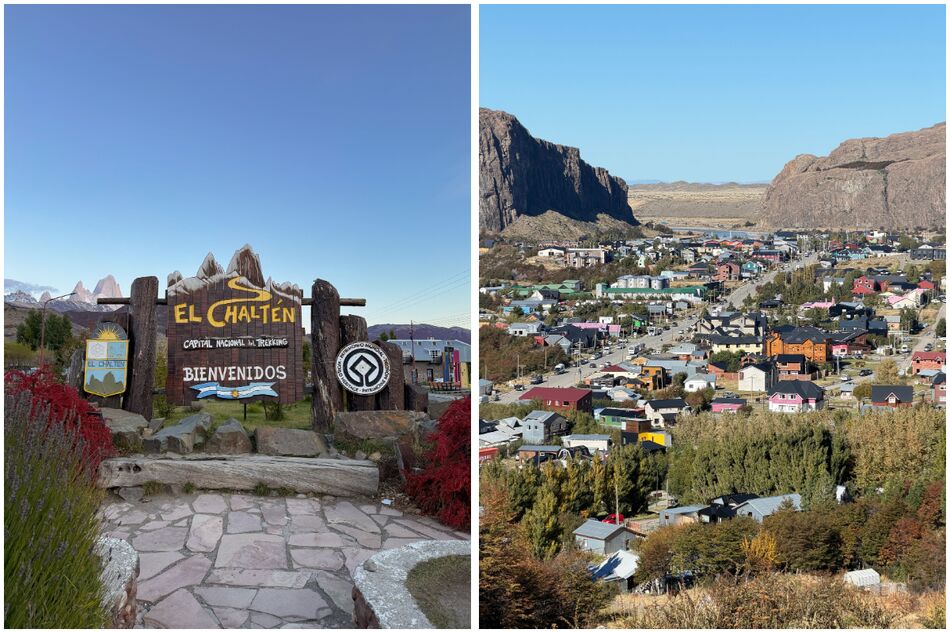
For somewhere that appears so remote when looking at a map, El Chaltén is remarkably straightforward to get to. The most direct option is to fly from Buenos Aires to El Calafate (3 hours, 20 minutes) and drive from there to El Chaltén (2 hours, 30 minutes). Either before or after visiting El Chaltén, you’ll also want to spend a night or two in El Calafate to make a trip to the majestic Perito Moreno Glacier.
El Calafate is also served by direct flights from Ushuaia (year-round) and Bariloche (September – March), so you can neatly tie in El Chaltén as part of a wider adventure through Argentine Patagonia.
It’s also possible – and highly recommended – to combine El Chaltén and El Calafate with Torres del Paine National Park in Chilean Patagonia. Depending on which order you want to arrange your itinerary, you can fly in or out of Puerto Natales or Punta Arenas, both of which have regular flight connections with Santiago.
When to go
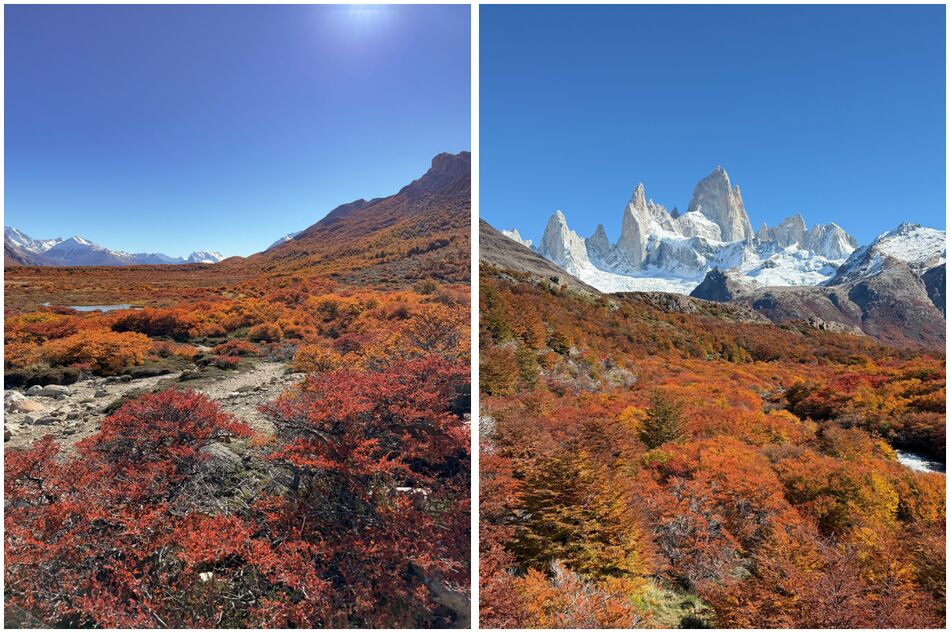
Austral autumn in El Chaltén, Patagonia, Argentina
The most popular time to visit El Chaltén is during austral summer (December – February), when the weather is at its mildest and the days are at their longest. At this time of year, temperatures typically reach daily highs of 15°C – 20°C, and the sun doesn’t set until around 10pm in the weeks either side of the summer solstice. Generally, this period offers the most reliable conditions for hiking.
However, it’s also worth considering the ‘shoulder’ periods of late spring and early autumn, when El Chaltén is noticeably quieter and there are far fewer people on the trails. In October, the hiking season starts to get going, and by November the landscapes burst into life as lingering snow and ice melt away. In March and April, the summer crowds dissipate and the air becomes that bit crisper as temperatures cool to single figures. The southern beech forests around El Chaltén come ablaze in shades of crimson, copper and amber during austral autumn; the precise timing varies from year to year, but the first week of April is usually a strong bet for peak fall colours.
From mid-April onwards, El Chaltén quickly winds down for the season, and by May, many restaurants, cafés and shops fully close down as only a few hardy adventurers remain in town. The winter months bring sub-zero temperatures, ice and heavy snowfall to higher elevations around El Chaltén, so hiking at this time of year generally isn’t recommended. During the shortest days of the year, there are as few as eight hours of daylight as the sun doesn’t rise until almost 10am.
Whenever you visit El Chaltén, be prepared for the possibility of ferocious winds and heavy rain; Patagonian weather is notoriously unpredictable and can change drastically from one hour to the next. It’s therefore essential to have proper hiking boots and quality waterproof layers, and always check the local forecast on Wind Guru before setting out on a hike.
How long to go for
Given the time, effort and expense required to get there, ideally allow for at least three or four nights (two or three full days) in El Chaltén. If the weather shapes up in your favour, this is enough time to complete a couple of the best day hikes, such as the trails to Laguna de los Tres and Laguna Torre.
However, the more days you have in El Chaltén, the better your chances of a suitable window of clear weather for attempting the more demanding hikes in favourable conditions. So, if you can spare five or six nights, you’ll have more scope to adapt your plans based on the latest weather – and also set aside a rest day or two, so you’re not cramming it all in.
Such is the variety of trails – both in the immediate surroundings of El Chaltén and slightly further afield – that you could easily spend a week or more and not run out of things to see and do. But for most people, the sweet spot is probably between four and six nights.
Things to do
The overwhelming majority of people come to El Chaltén for exactly the same reason – to enjoy some of the finest hiking trails in Patagonia, and indeed anywhere on Earth. The trails vary significantly in terms of length, difficulty and terrain, and almost all of them start and end in the town itself, so there’s no need to hire a car. Before you set out on a hike, be sure to purchase a visitor’s pass for Los Glaciares National Park, which will grant you access to all the trails in and around El Chaltén.
To give you a taste of the possibilities, here’s an overview of the main hiking trails in El Chaltén.
Laguna de los Tres
Total length/duration: 24 kilometres (7-10 hours)
Difficulty: High
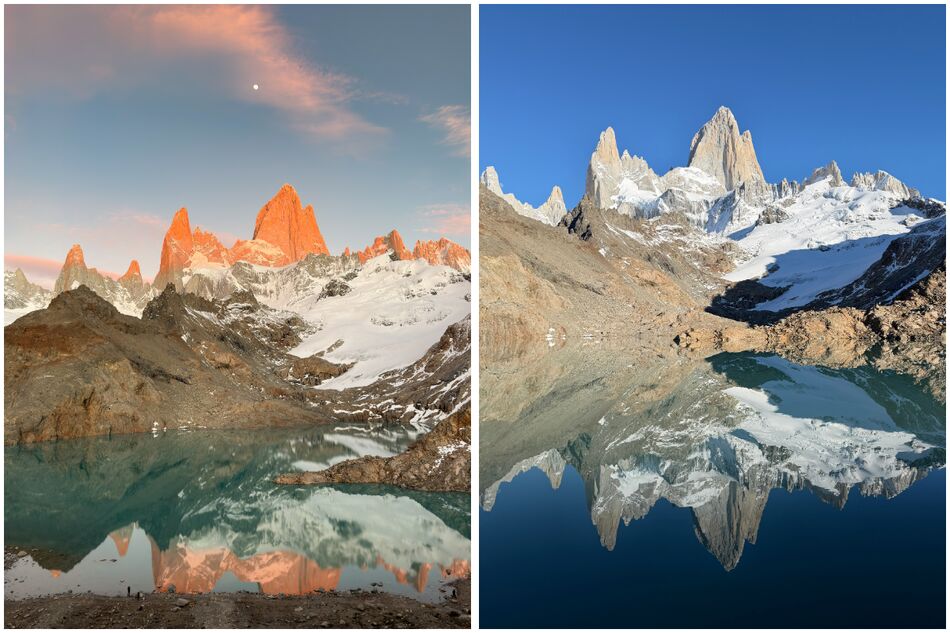
Laguna de los Tres at sunrise (left) and after sunrise (right)
If you only attempt one big hike in El Chaltén, this is the one. The trail begins at the northern end of Avenida San Martín with a steady ascent for the first few kilometres before flattening out as you wind through an open valley carpeted with southern beech forest. Then, shortly after crossing a fast-flowing glacial river (Río Blanco) on a wooden footbridge, it’s a gruelling final ascent of 400 metres up loose, boulder-strewn moraine, before reaching Laguna de los Tres. The last stretch is a brutal, energy-sapping ordeal, but the rewards at the top are absolutely worth it; the views of Mount Fitz Roy (the mountain depicted on the Patagonia logo) and its neighbouring peaks, with the glacial lagoon in the foreground, are utterly awe-inspiring.
If you’re lucky enough for it to be a still day with low winds, the lagoon appears like a glassy mirror, perfectly reflecting Fitz Roy. For the ultimate experience, start the hike in the night with a head torch and plan to reach Laguna de los Tres in time for sunrise, when the mountains are bathed in glorious shades of pink and orange as they catch the first diffuse rays of the sun. Then, on the way back, you’ll be able to see everything you missed in the dark on the way up; be sure to stop by Laguna Capri and Cascada Escondida for more terrific views of Fitz Roy from a distance.
Laguna Torre
Total length/duration: 18 kilometres (5-7 hours)
Difficulty: Moderate
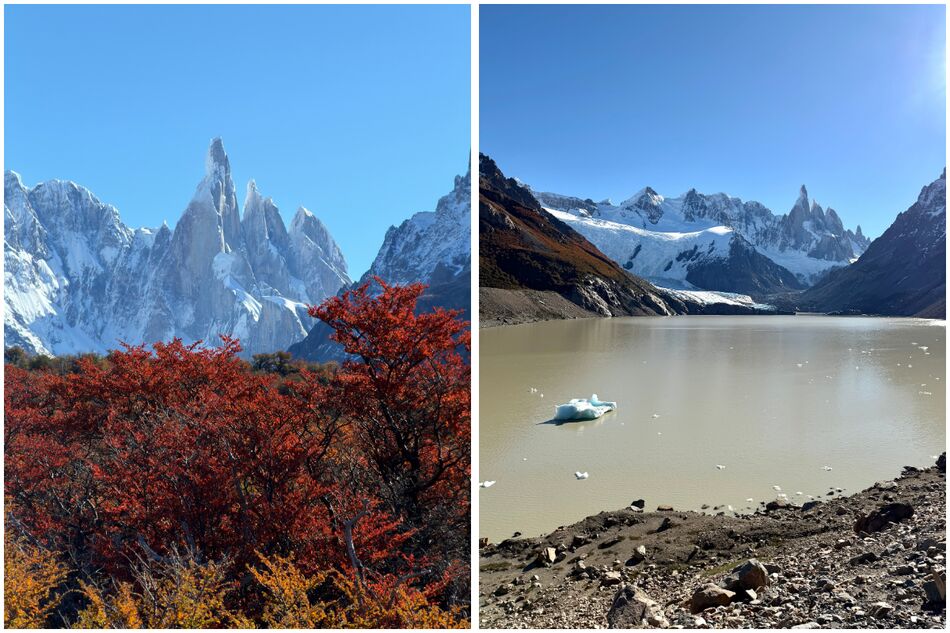
Autumn on the trail to Laguna Torre
After Laguna de los Tres, this is the second-most popular hike from El Chaltén – and it’s considerably easier, too, as most of it is flat with some gently undulating sections along the way. The trail weaves along the forested floor of the Río Fitz Roy valley, culminating at an iceberg-speckled lagoon beneath the Torre Glacier and the chisel-like granite spire of Cerro Torre. If you’re not certain about completing the whole hike, there’s a fantastic viewpoint (Mirador Torre) around four kilometres in, where you can either decide to continue or head back to El Chaltén. This is one of the best trails to observe autumn colours at their most spectacular in late March or early April.
Loma del Pliegue Tumbado
Total length/duration: 20 kilometres (6-8 hours)
Difficulty: Moderate to high
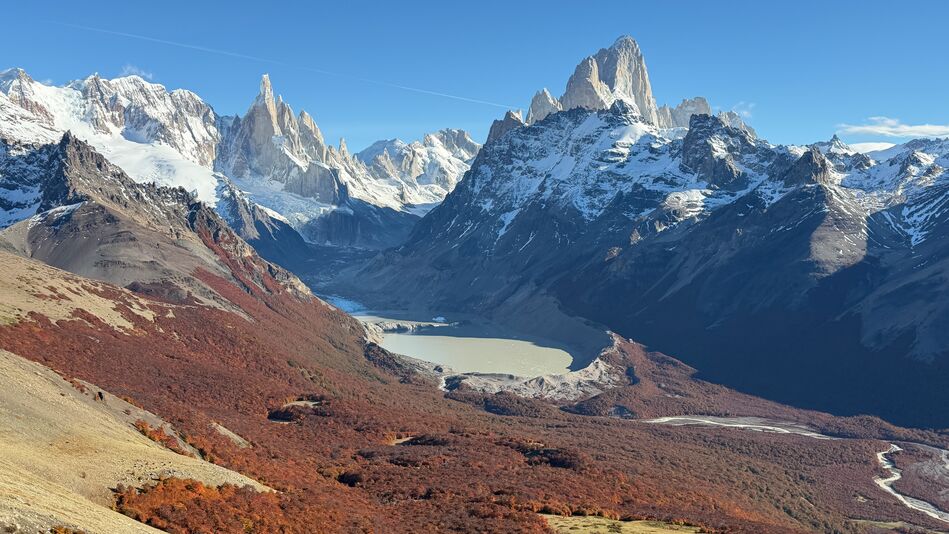
View of Cerro Torre and Mount Fitz Roy from Loma del Pliegue Tumbdao
Many visitors to El Chaltén skip Loma del Pliegue Tumbado, but if you have the time (and energy) for it, this is one of the most rewarding trails in the area. It involves a gradual ascent through lenga forests before emerging at the top of an exposed, rocky hill with jaw-dropping panoramic views of the Andes in one direction and Lago Viedma and the Patagonian steppe in the other. From this elevated vantage point, you can see both Cerro Torre and Mount Fitz Roy from a completely different angle, and it really puts the dramatic topography of the region into perspective. Due to the exposed nature of the upper section, this hike is best avoided on days with high winds or poor visibility.
Mirador de los Cóndores
Total length/duration: 2.5 kilometres (45 mins – 1 hr)
Difficulty: Low
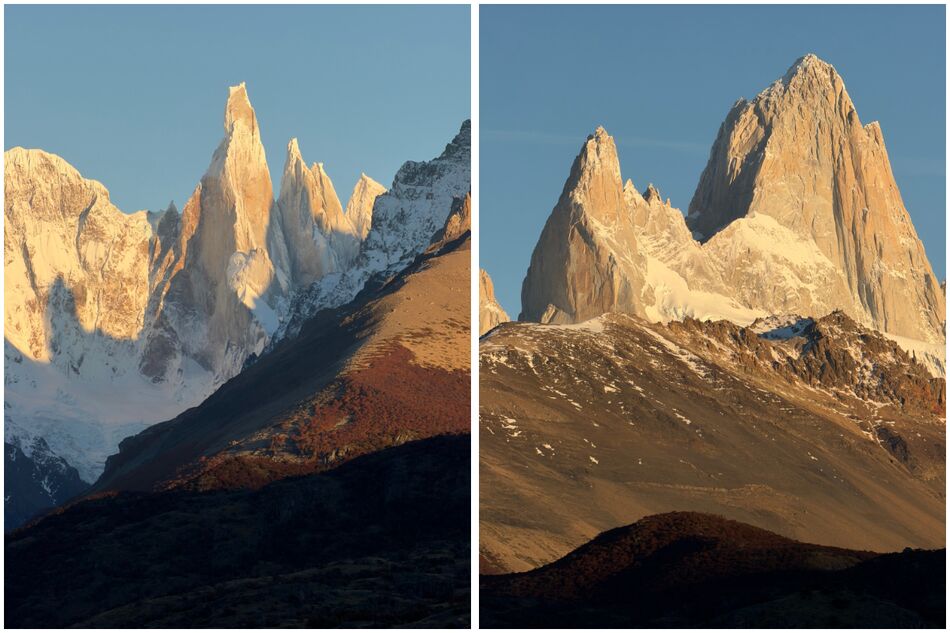
Sunrise views from Mirador de los Cóndores
In terms of effort-to-reward ratio, this is perhaps the best short hike in El Chaltén. It brings you up to a hilltop viewpoint just above the town, from which, on a clear day, you’re met by superb views of Mount Fitz Roy, Cerro Torre and their neighbouring peaks. It’s a great alternative option at sunrise if you want to catch the pinky-orange alpenglow on the mountains without having to wake up in the middle of the night to hike all the way to Laguna de los Tres or Laguna Torre. Afterwards, there’s the option to continue a little further to Mirador de las Águilas, which offers impressive views of the mountains as well as the Patagonian steppe stretching out alongside Lago Viedma.
Chorrillo del Salto
Total length/duration: 6.5 kilometres (1-2 hrs)
Difficulty: Low
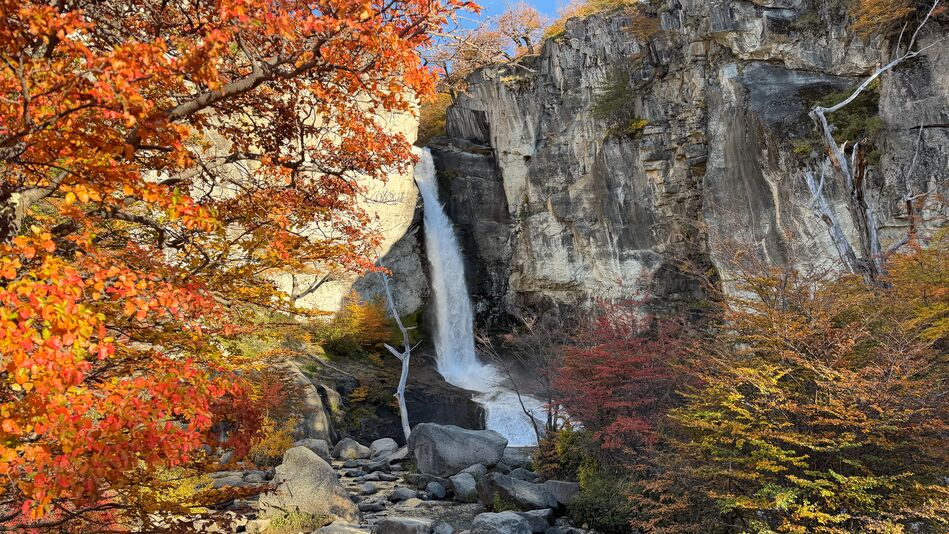
Chorrillo del Salto near El Chaltén, Patagonia, Argentina
This fairly short, almost entirely flat trail meanders along the valley floor of the Río de las Vueltas before reaching the Chorrillo del Salto waterfall – a 20-metre cascade of glacial meltwater tucked away among lenga forests. It’s a perfect choice for a recovery day after tackling some of the more demanding hikes from El Chaltén.
Other activities in El Chaltén
While most visitors tend to focus on the above hikes in El Chaltén, it’s also possible to venture further into the surrounding region in search of other adventures. One option involves driving 37 kilometres north along Route 23 to Lago del Desierto, a glacial lake surrounded by lenga and ñire forest. An easily accessible hike here leads to a turquoise lagoon beneath the hanging Huemul Glacier, with views looking back towards Mount Fitz Roy from the north. Another popular choice is a boat cruise on Lago Viedma, which offers up-close views of the Viedma Glacier – one of the largest glaciers in Argentine Patagonia.
Where to stay
There’s a wide variety of accommodation to suit different tastes and requirements in El Chaltén, ranging from high-end, boutique hotels to basic, functional lodges for budget-conscious travellers. Among the highest-rated options in town are Los Cerros Boutique Hotel and Destino Sur Hotel & Spa de Montaña, both of which have their own spa facilities – perfect for post-hike relaxation.
If you’d prefer a more remote, immersive wilderness experience, consider Explora El Chaltén – a luxury, all-inclusive lodge within the 14,000-acre Los Huemules Conservation, around 17 kilometres north of El Chaltén. It offers a wide range of guided hikes, a full-service spa with outdoor hot tubs, and a restaurant that prepares hearty, open-fire dishes inspired by the culinary traditions of Argentine Patagonia – paired with delicious cocktails and a wide range of regional wines.
Where to eat & drink
Considering its compact size and remote setting, El Chaltén boasts a surprisingly impressive dining scene – largely concentrated along Avenida San Martín. You’ll find everything from cosy, traditional parillas (grillhouses) and rustic pizzerias to laid-back burger bars and more upscale restaurants specialising in classic Patagonian fare. Being in Argentina, red meat – mostly beef and lamb – features prominently on most menus, but it’s not difficult to find alternative options.
If you’re after authentic Argentine cuisine, The Asadores, La Tapera and La Oveja Negra are standout options, while Maffia (homemade pasta), Laborum (pizza) and La Cervecería (hearty comfort food and local beer) are all excellent post-hike venues. Heladería Domo Blanco does the best ice cream in town, with flavours that include Calafate berry and a whole host of dulce de leche varieties.
For a good beer, even better burgers and a buzzing evening atmosphere, head to Fresco Bar – and if you’re a craft beer enthusiast, you’ll be in your element at Cerveceria Patagonia, which serves a terrific range of lagers, pale ales, IPAs and darker beers on draft. Many bars in El Chaltén offer heavily discounted happy hour prices in the afternoons, so if you fancy a post-hike drink or two, there are plenty of enticing options dotted all along Avenida San Martín.

