A place fitter to represent the infernal regions could scarcely, in searching the world around, be found. Death, I exclaimed, would be preferable to banishment in such a country.
Charles J Andersson, 19th-century explorer
Namibia holiday experts at WEXAS will tailor-make all aspects of your itinerary to create a Namibia holiday, personal to you.
Namibia may once have been one of the worst places to find yourself in the world, at the mercy of the beating sun and without drinking water, but today it stands as one of the most spectacular and varied countries anywhere on earth. Not only can you see spectacular landscapes and abundant wildlife, you’ll also witness time.
Travelling from Botswana across the north of the country, the first thing to see is the Hoba meteorite just outside Grootfontein. This 60 tonne lump of iron is the largest meteor yet discovered on the planet, but bizarrely no crater can be seen – a mark of how quickly things erode in these parts, or perhaps due to it smashing into the earth at a very low angle.
Heading west, next up is Etosha National Park. The ‘Great White Place of Dry Water’, as it’s otherwise known, is made up of 20,000 square kilometres around the seemingly endless saltpan. More than 100 mammal species can be seen here, around 300 bird species and a handful of reptiles. Its definitely worth a visit, simply because its so different, so barren, in comparison to other national parks and game reserves across East and Southern Africa.
On from here and you soon reach the Atlantic, by way of a petrified forest. The stone trees, now lying on the floor, still show the rings of growth and the bark has maintained its shape. After a short visit, it’s on to the Skeleton Coast, the stretch of land Charles Anderson refers to in the quote above. Hazardous currents and sandbanks have wrecked numerous ships on the coastline, and the unfortunate sailors, initially pleased to find diamonds in the sand, would eventually succumb to the heat and lack of water. Their remains the reason for the region’s haunting name.
Turning south you soon reach Cape Cross Seal Colony, where hundreds of thousands of what are actually sea lions come to breed. It’s a fantastic sight and the sound of them barking is also something to behold, however the smell is something else entirely – and a reason why tourists don’t stay to watch too long.
A little further is Swakopmund, a seaside town, full of Germanic character, and a good base from which to explore the nearby sanddunes by quadbike or sandboard. Walvis Bay, nearby, is a quieter town in comparison, and a favourite for birdwatchers.
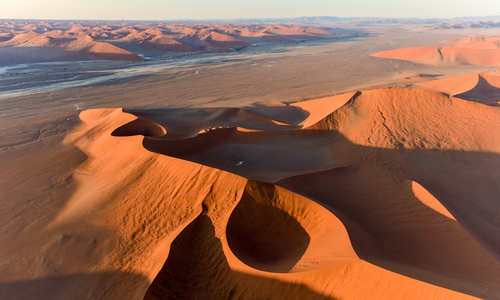
Head to Sossusvlei and the Namib-Naukluft National Park for sunrise or sunset, to watch the changing hues of the world’s largest sanddunes. Dune 45 is a favourite loaction for this, and likely one of the most photographed sanddunes anywhere.
Lüderitz Bay is a quirky fishing port with the dubious distinction of housing one of the first concentration camps on Shark Island. Used by the Germans to round up the Herero people, it had an extremely high mortality rate. Today it is possible to camp there and its history is largely forgotten.
Nearby is the ghost town of Kolmanskop, once a diamond mining town, the houses are now engulfed in sand and, perhaps, will soon disappear from sight. It’s a stark reminder to how nature is in charge here.
Finally, in Namibia’s southern reaches, is Fish River Canyon. Over time water flowing toward the Atlantic has carved one of the most impressive canyons, and indeed landscapes, on earth. Though it is the second largest, after the Grand Canyon, it is significantly easier to walk to river level and back in an afternoon.
Namibia tailor-made holiday highlights
Damaraland This extremely arid region has much to see: the petrified forest whose trunks turned to stone 200 million years ago, Vingerklip, a pale, 35-metre-high monolith that dominates the skyline, and Twyfelfontein, home to an abundance of ancient rock engravings.
East of EtoshaA short drive from Grootfontein, on the Hoba farm, is one of the largest meteorites discovered. Mainly iron and weighing 50 tons, it is thought to have hit earth some 80,000 years ago. Erongo See amazing red rock formations that make great photos, and sleep under the stars at Spitzkoppe.
Namib Desert Stay at Swakopmund for trips into the Namib, where sand dunes stretch as far as the eye can see. Ride them on plywood or quad bikes or take part in one of the many other adventure activities. Further down the coast visit the multitude of Cape Fur Seals at Walvis Bay. To visit the high red sand dunes of Sossusvlei one can stay at one of the many accommodations in the area near Sesriem. On the southwest coast one can stay at the Luderitz campsite on Shark Island, bear in mind that this was once a concentration camp, holding the Nama and Herero people in 1904-1908. From Luderitz, take a trip to the ghost town of Kolmanskop, once a diamond-mining town, now mostly buried under dunes.
Fish River CanyonA huge, dramatic cleft in the dry landscape and one of the world's largest canyons. Unseen until you are on top of it, it has a vertical drop from the plateau for half a kilometre.
Etosha National Park One of Africa's greatest wildlife parks, with lion, elephant, zebra and more. Within the park lies the Etosha Pan, a huge, salty hollow that was formed 1,000 million years ago.
Caprivi StripNarrow section of land, bordered by Botswana to the south and Angola and Zambia to the north. The region is popular with bird watchers, with fish eagles, bee-eaters and the rare Angola swallow among the species sighted here. Game viewing can be done in a 4x4 vehicle or in a more traditional mokoro, a type of dugout wooden canoe, for excellent viewing along the riverbanks.
People & place
Namibia facts
Capital: Windhoek
Language: English is the official language. Afrikaans is widely spoken. German and indigenous languages - including Oshivambo, Herero and Nama - are also spoken
People: Ovambo (50%), Kavango, Damara, Herero, Himba, Nama, Baster, (San) Bushman, Tswana, Caprivians.
Religion: Christian majority.
Size (sq km): 825,418.
Population: 2,008,669.
Population density/sq km: 2.43.
Etiquette
Western customs are held in Namibia and normal courtesies apply.
Shopping
Diamonds, semi-precious stones, Herero dolls, woodcarvings, jewellery, karosse rugs, liqueur chocolates.
Food & drink
Game is a speciality. Biltong (air-dried meat) and rauchfleisch (smoked meat) are popular. Restaurants and cafes are still under the German influence.
International Airports
Windhoek (WDH) 40 km from the city.
Internal travel
Flying is the quickest and sometimes most economical way to travel around the country. Planes can also be chartered. Efficient rail service, although limited in extent. Luxury coaches run between Windhoek and Cape Town in South Africa. Local mini buses run between Oshakati and Keetmanshoop. Roads are generally well maintained. Car hire available.
Red tape
Visas
(UK/US) None.
Vaccinations
BCG, Cholera, Hep. A, Hep. B, Malaria, Polio, Rabies, Typhoid, Y. Fever2.
Driving requirements
If licence is not in English then one must take an International Driving Permit.
Reps in UK/US
UK: 6 Chandos Street, London W1G 9LU, tel (020) 7636 6244, fax (020) 7637 5694, email namibia-highcomm@btconnect.com. US: 1605 New Hampshire Avenue, NW, Washington, DC 20009, tel (202) 986 0540, fax (202) 986 0443, email embnamibia@aol.com.
UK/US reps in Namibia
UK: PO Box 22202, 116 Robert Mugabe Avenue, Windhoek, tel (61) 274 800, fax (61) 228 895, email windhoek.general@fco.gov.uk. US: Private Bag 12029, 14 Lossen Street, Windhoek, tel (61) 221 601, fax (61) 229 792, email HealyKC2@state.gov.
Currency
Namibian dollar (N$). It is linked on a one-to-one basis with the South African rand.
Finance
Credit cards and traveller's cheques are generally accepted.
Business hours
0800-1700 Monday-Friday.
Safety & life expectancy
Safety information
Mostly Safe. Landmines are still present along the Angola border and the Caprivi region.
Life expectancy
Life expectancy: M 50.39, F 49.38.
Useful websites for travel
www.namibiatourism.com.na, www.britishhighcommission.gov.uk/namibia, www.namibianembassyusa.org.
Local media
The Windhoek Advertiser, The Namibian are published daily in English, the Windhoek Advertiser weekly and the New Era twice a week.
Tourist boards
UK Namibia Tourism, Suite 200, Parkway House, Sheen Lane, London SW14 8LS, tel (0870) 330 9333, fax (020) 8878 9124, email info@namibiatourism.co.uk
Namibia tailor-made holiday ideas
Damaraland
This extremely arid region has much to see: the petrified forest whose trunks turned to stone 200 million years ago, Vingerklip, a pale, 35-metre-high monolith that dominates the skyline, and Twyfelfontein, home to an abundance of ancient rock engravings.
East of Etosha
A short drive from Grootfontein, on the Hoba farm, is one of the largest meteorites discovered. Mainly iron and weighing 50 tons, it is thought to have hit earth some 80,000 years ago. Erongo See amazing red rock formations that make great photos, and sleep under the stars at Spitzkoppe.
Namib Desert
Stay at Swakopmund for trips into the Namib, where sand dunes stretch as far as the eye can see. Ride them on plywood or quad bikes or take part in one of the many other adventure activities. Further down the coast visit the multitude of Cape Fur Seals at Walvis Bay. To visit the high red sand dunes of Sossusvlei one can stay at one of the many accommodations in the area near Sesriem. On the southwest coast one can stay at the Luderitz campsite on Shark Island, bear in mind that this was once a concentration camp, holding the Nama and Herero people in 1904-1908. From Luderitz, take a trip to the ghost town of Kolmanskop, once a diamond-mining town, now mostly buried under dunes.
Fish River Canyon
A huge, dramatic cleft in the dry landscape and one of the world's largest canyons. Unseen until you are on top of it, it has a vertical drop from the plateau for half a kilometre.
Etosha National Park
One of Africa's greatest wildlife parks, with lion, elephant, zebra and more. Within the park lies the Etosha Pan, a huge, salty hollow that was formed 1,000 million years ago.
Caprivi Strip
Narrow section of land, bordered by Botswana to the south and Angola and Zambia to the north. The region is popular with bird watchers, with fish eagles, bee-eaters and the rare Angola swallow among the species sighted here. Game viewing can be done in a 4x4 vehicle or in a more traditional mokoro, a type of dugout wooden canoe, for excellent viewing along the riverbanks.

This self-drive explores some of the iconic sights in this vast country while giving the option of staying in two standards of accommodation. Explore the plains of the Namib Desert, the apricot dunes of Sossusvlei, the charming coastal town of Swakopmund, the ...
Price from £2246
More information »

The Namibia All-in-one Fly-in safari takes you to Namibia’s main highlights in comfort and style travelling by small, private chartered aircraft, saving you time and allowing you to explore more of this vast and exciting country in a shorter period of ti...
Price from £5373
More information »

Explore the bare plains of the Namib Desert, the apricot coloured dunes of Sossusvlei, the romantic coastal town of Swakopmund nestled between the Ocean and the Desert, the rough terrain of Damaraland and the abundant wildlife in the world renowned Etosha Nati...
Price from £3555
More information »